Blue Skies for Education
Dems can deliver on PreK-12 while addressing affordability and corruption

Within days of the Democrats’ astounding, resounding midterm performance, the New York Times published a piece questioning whether Texas governor-elect Gina Hinojosa can deliver on her promises with respect to preK-12 schools. The Times highlighted key constraints: the GOP’s years of work toward privatizing and Christianizing education and its continued control of the State Senate.
Of course a single governor in her first term cannot undo the decades of damaging work done at the state and federal level by billionaires, powerful churches, politicians, and a beholden Supreme Court to weaken public education. No one expects that.
Across the nation and together, though, Democrats at the local, state, and federal level can deliver a lot. They have to: MAGA has made moves harmful to public ed and to children that must be reversed. This is also the first meaningful opportunity this century that Dems have had to deliver on voters’ desires and children’s needs with respect to schools. They can do it by dedicating more dollars to education, all while answering Americans’ calls for them to tackle affordability and corruption.
Democrats will only succeed, however, if they refuse the framing of key preK-12 issues that has been set by the right — but which many centrists have embraced and media outlets have adopted.
This needs to go: “Schools face inevitable budget shortfalls due to ___________.” The blank has been filled in by various crises, most notably the 2008-09 global financial disaster. Lately it’s declining birth rates, which pols, pundits, and journalists have accepted as a reason why education budgets must shrink and schools must close. This pain is necessary, the public is told — when it is anything but.

Dems — and, I’m begging, the media — must resist the idea that fewer students means we can’t spend as much to educate America. This framing accepts austerity as a controlling mindset, accepts inequitable overreliance on local funding, accepts inadequate taxation of the wealthiest and corporations.
Yes, fixed costs can make it hard for districts when enrollment drops, but school closings are not the answer. A new study out of Stanford shows that closures in California had on average a negligible effect on budgets as they worsened enrollment and disrupted children’s education, upended parents’ and educators’ lives, and shook entire communities. Democrats need to show that they are the party that can keep schools open in the urban, suburban, and rural neighborhoods and towns that depend on them.
More generally, school budget crises are not inevitable. The most recent in many areas were precipitated by the end of pandemic funding, which could have been avoided, of course, by renewing that funding. In the end it’s a matter of priorities.
While Trump’s 2027 budget called for $8 billion in cuts to preK-12 spending, he asked for an additional half a trillion in military spending. In other words, our leaders always manage to procure enormous funds for bombs and planes. We can get more for books and teachers by taking funds from the top five military contractors to hire reading specialists and math tutors. Fund more school meals, supplies, after-school programs, and transportation, all of which gives relief to household budgets.
 Anne Lutz Fernandez
Voters want the government to devote more resources to schools and less on war. Democrats can and should restore the Department of Education and increase funding to the states for schools. They can repeal Trump’s 2025 tax cuts for the rich to pay for the increase — and if the logic of austerity is to be applied, apply it to the Pentagon.
Here’s another: “Spending on public education doesn't make a difference." The right bangs the drum on the “failure” of public schools despite higher spending by states and municipalities. They ignore that over the past two decades, families and districts have faced the Great Recession, a deadly global pandemic, and surging political and gun violence. Students have been distracted by cell phones, other devices, and social media. Teachers have been overworked and underpaid.
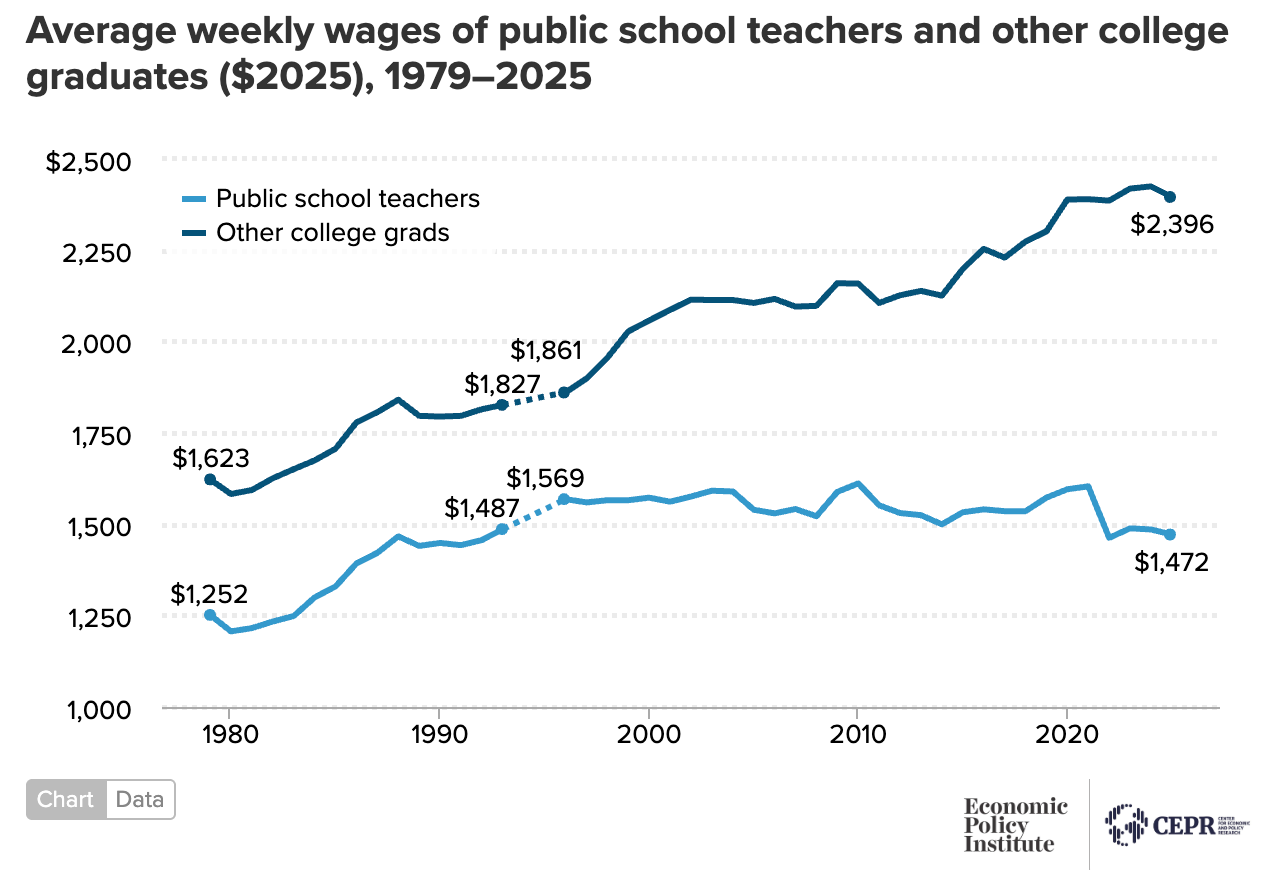
How can teachers be underpaid if school spending is rising? For one, schools have been overpaying for school security and cybersecurity and on useless edtech (not my word, but The Economist’s) from the corrupt tech bros. They’ve been spending on administrators as government micromanagement has required more bureaucracy and unfunded mandates. They’ve also been spending more to provide physical and mental health care resources for students, and on increased health care costs for staff.
While there are better and worse ways for districts to spend education dollars, if test scores are the measure, a 2024 metanalysis by Northwestern economists showed a meaningful boost in them for each $1,000 of additional per-pupil spending — in public schools. Instead, of course, the GOP has been spending billions on vouchers in many states for private, mostly religious schools often with little to no accountability for outcomes, even when voters are opposed to it, and when fraud and corruption in many programs is already rampant.
Voters understand teachers aren’t being paid fairly and want them to be: 94% of voters in generally pro-education “choice” Florida support more pay for teachers.
Yet mainstream media outlets often echo the right’s line on education spending, regurgitates its language about “failing” and “broken” schools, and assumes the need for austerity when evaluating proposals for improving schools. In the Times’s recent “30 Ideas for Fixing U.S. Schools, Ranked by Experts,” costs are deemed as salient as effectiveness. This could be called realism in a land that has refused for decades to raise revenue fairly, but it’s also the kind of submission to right-wing framing that has helped delay this new, blue day.
So what can be done, knowing voters want the government to devote more resources to schools — public schools, which they can have a voice in? Restore the Department of Education and repeal the federal voucher program passed as part of the Big Brutal Bill. Rebuild the ACA and expand access to Medicare to help families but also so districts don’t have to spend so much on benefits packages for teachers and can raise salaries. Rein in existing state voucher programs and reject new ones.
 Anne Lutz Fernandez
Breaking these frames and others such as “schools should be run like businesses” is essential — because what Democrats must do is get larger, steady streams of funding to public schools. If they don’t, they can’t provide the things voters and parents want: safer, healthier, local schools that are vibrant places of learning and communities that pull together for all kids, not just their own.