What Does a “Learning Recession” Mean?
For one thing, that we need to beware of failed reforms cycling back

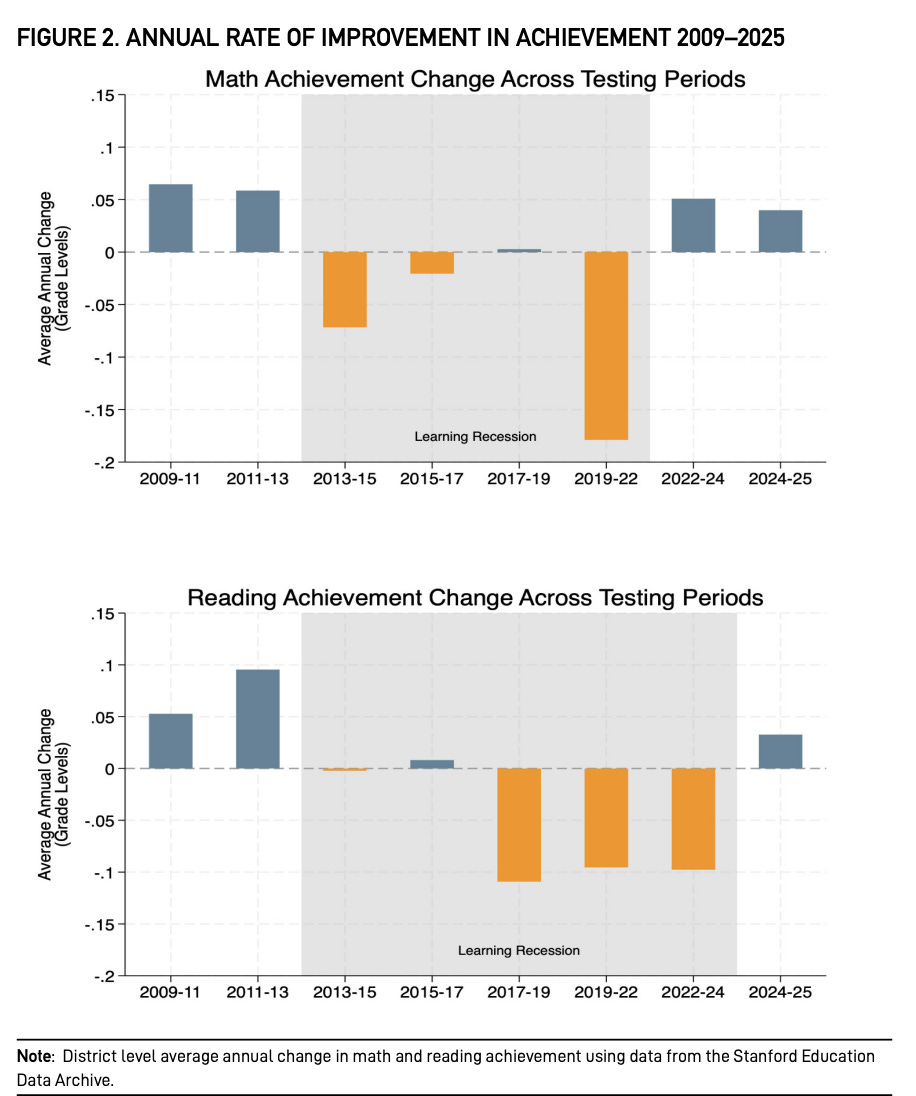
If you’ve heard anything regarding K-12 schools this week, it was probably about new research on the decade-long struggle to improve scores on standardized tests. A report by a joint project of three universities has generated (by the standards of education news) a flurry of media coverage.
The research shows how performance on state tests was waning well before the pandemic started—and that current underperformance crosses region, race, and class. I have work to do to fully scour the report, but I already have thoughts.
The value of the report
Teachers and professors nationwide have been sounding the alarm for some time about the declines in student skills, knowledge, and behavior they’ve been seeing first hand, much of which can’t be measured by standardized tests. But test scores are all that many political and educational leaders heed when it comes to school success, so the study is valuable in confirming what teachers know—and providing motivation for needed reforms.
The project’s report makes clear that declines preceded the pandemic, which should help rescue the discourse from the eddy of blame set aswirl by those using school closures to facilitate school privatization. And the data showing issues in wealthier districts and schools with majority-White populations makes politicians and elected officials more likely to pay attention to K-12.
The report highlights the value of increased spending on education: The recovery since 2022, the authors write, “has been ‘U-shaped,’ with larger improvements among the highest and the lowest income school districts in the country,” citing federal pandemic dollars as the reason for gains in low income areas.
The granularity, methodology, and helpful visual tools accompanying the report highlight a bevy of schools and districts performing above average, which may prompt the media to expand their coverage from the well-covered Southern Surge. It should also help administrators learn from the experiences of schools like their own. Running a large district with below-average household income? The data suggests there are lessons to learn from Detroit, Baltimore, and Atlanta.
No single cause, no silver bullets
In its coverage of the report, the New York Times signaled caution about identifying the decline’s causes, aware that readers have their own usual suspects.
Having taught secondary English from 2000 to 2024, I have mine: technology. I saw the introduction of electronic grade books feed anxiety and grade inflation. Online “study guides” such as SparkNotes in the aughts, smartphones and 1:1 device programs in the teens, and the rising influx of “mostly useless” edtech throughout the era helped students avoid reading, writing, and thinking.
The report’s authors identify two correlations they find most compelling, one of which is tech-related. Sadly, they limit this to social media and cell phones, ignoring the tech pushed on teachers and students by schools. The second is the “dismantling of test-based accountability,” by which they mean the regime erected by Bush’s No Child Left Behind and Obama’s Race to the Top. Focus on these two factors unfortunately oversimplifies the job ahead: there are no silver bullets.
The focus also implicitly lays blame on three groups: parents (who after all, buy the phones), students (who spend so much time on social media) and teachers (targets of the accountability regime that the report credits with pre-2013 gains.)
But teachers I talked to across the country researching Schooled from 2012 to 2014 underscored that America’s challenges in teaching and learning are the result of a complex web of weighty in- and out-of-school factors. They include powerful forces outside the control of parents and teachers: deep income inequality and widespread poverty; inadequate healthcare; high rates of violence; inconsistent, insufficient funding. They include school leaders’ susceptibility to pedagogical fads and political and corporate pressures and to shifting ideas about the value and purpose of education.
These teachers pointed to the “accountability” regime, the contraction of which the report bemoans, as much more of a hindrance than a help. It was oppressive to teachers and students alike. Melissa Lazarín found in 2014 that students were taking up to 20 standardized tests a year; another study at that time calculated that by high school graduation, the average student in large districts had taken 112 tests.
Much has been written by Diane Ravitch and others about how the regime warped curriculum, sucked up instructional time, affected student mental health, drove away teachers, and facilitated the vouchers now siphoning taxpayer dollars from public schools.
Taking a warning from the language
As alarming as the data is, specific language of the report also put me on edge, particularly this with which the report opens: “The United States entered a ‘learning recession’ in 2013, as student progress in math and reading stalled and achievement began to decline.” The media took the catchy language and ran:
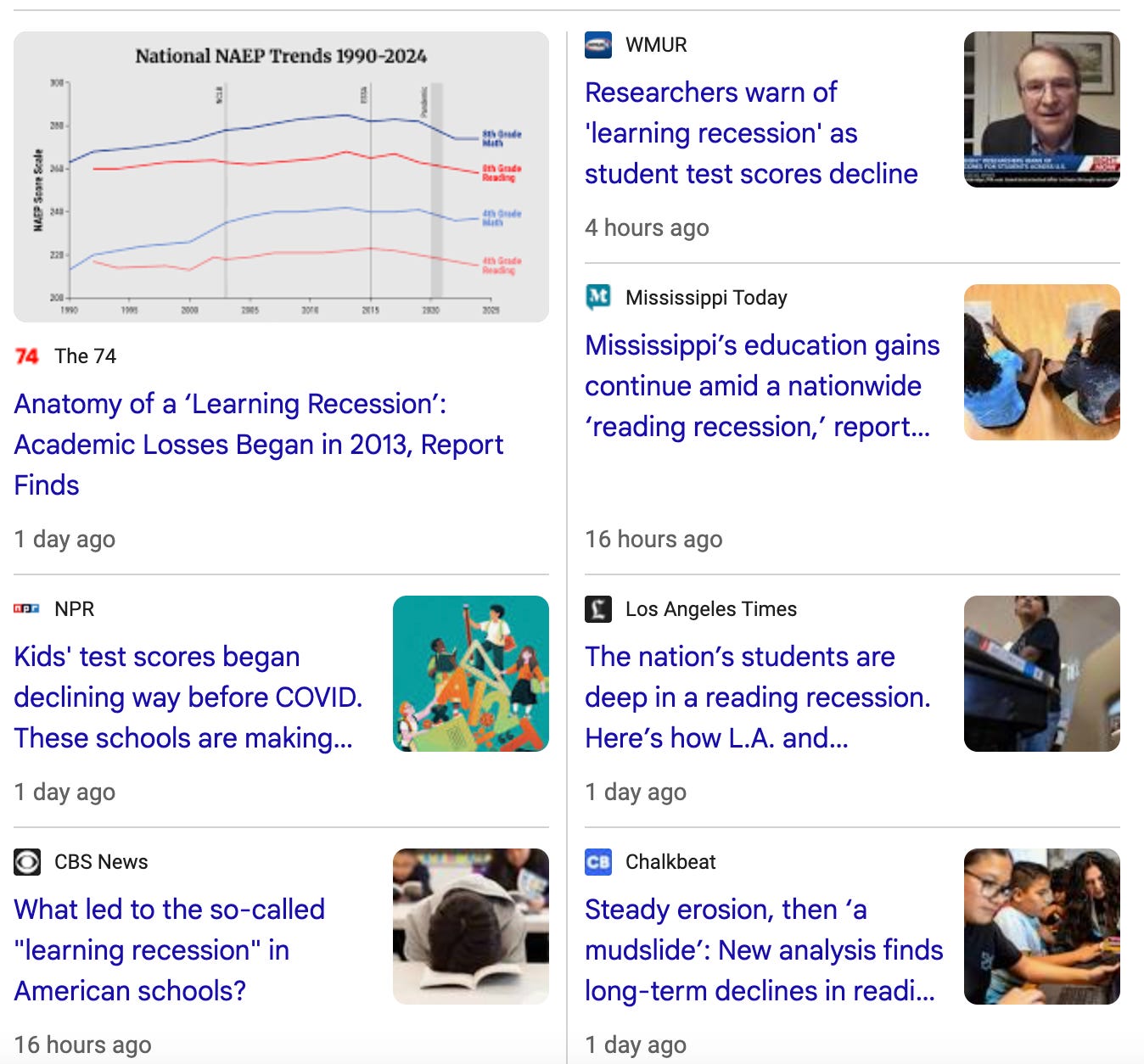
The problem with this phraseology is that it frames the crisis as one not of culture or human systems but one of business and economics. A key legacy of the accountability regime and its heavy reliance on standardized testing is the inability of politicians and pundits to see or discuss the work of schools in other terms. Advocates for free school meals, for example, must argue on the basis of test score gains rather than as a practical convenience for families, a matter of public health—or in moral terms as humane treatment of vulnerable children.
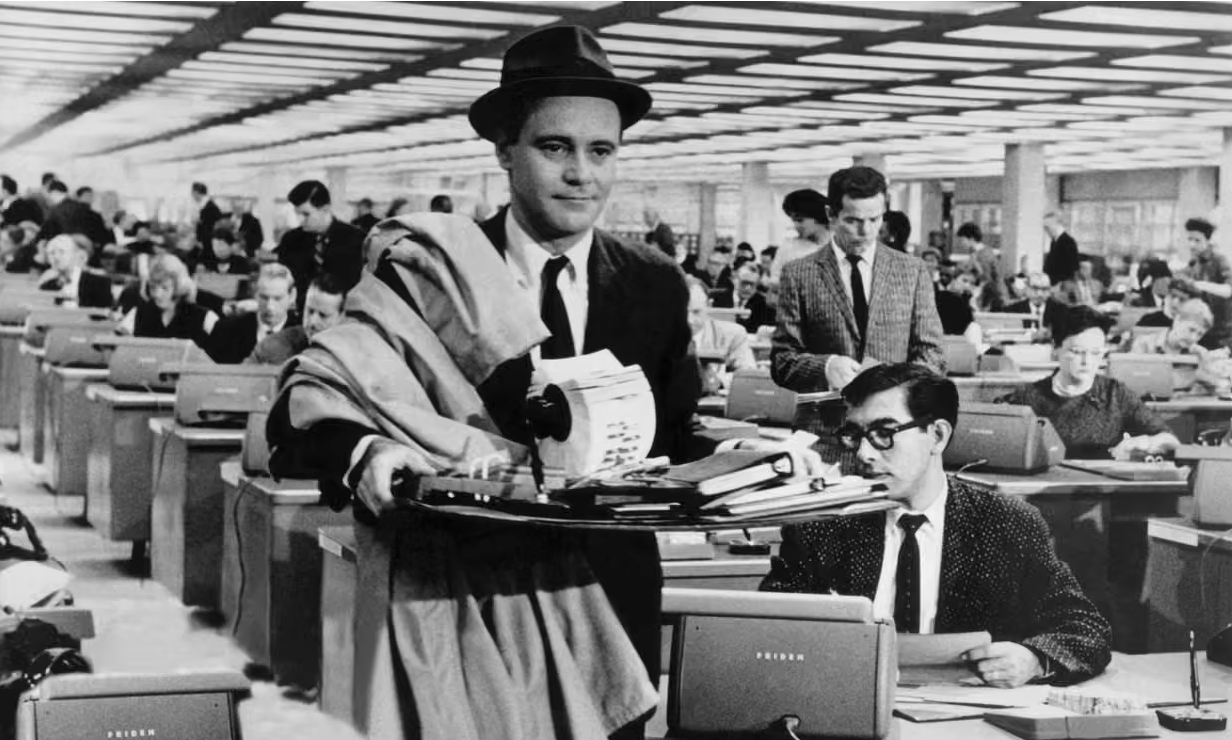
The assessments and evaluations required by the accountability regime turbo-charged the edtech industry, which helped turn students into little office workers completing tasks on office equipment for much of the day. While there was a great deal of sales talk about 21st century learning, corporatizing education has made schools look more like mid-20th century office buildings.
No group other than the tech industry benefited more from trying to run schools like a business than the proponents of private school vouchers and ESAs, who claimed that “competition” would lead to improvements in public schools. Yet, as Josh Cowen has repeatedly demonstrated, voucher schools and homeschool parents receiving tax dollars have far less transparency and fewer accountability mechanisms than public schools have currently. They are held to a vastly different standard.
As a businessperson-turned-teacher, I can’t emphasize enough that to talk of a “learning recession” in public schools is to beckon to the ideology of the free market and business methods that cannot be sensibly applied to K-12 schooling. (Just read one of Peter Greene’s several good pieces explaining why.) The language suggests a return to the failed regime of the past, whose agents and architects such as Obama Education Secretary Arne Duncan have been making the press rounds pushing federal vouchers.
The lessons of this new report will not come from looking to the past but to the present, including to schools that are performing better than the rest. Answers to our educational problems can’t focus solely or even largely on schools, however.
Test scores don’t measure everything, but they result from what happens in school and at home and in the wider world. The fight will be to make sure solutions reach beyond the schoolhouse door because a lot of what’s getting in the way of children’s learning—from climate disasters to political violence to anti-intellectualism to austerity and so much more—keeps flooding in.