We Reshaped the Landscape for Cars, Not People. Will We Do the Same for AI?
On a gobsmacking interview with Nvidia's CEO
Every so often, a news item hits all my pressure points at once and nearly knocks me out. This week it was an AP interview with Jensen Huang, one of the world’s richest men and head of the largest market value company in the US, Nvidia, which provides the hardware for AI data centers.
In the interview, in which Huang pleaded for national “enthusiasm” for AI, he compared AI to the (arguably) most influential technology shaping American life in the twentieth century, the automobile. It was an extraordinarily apt analogy — and an unfortunate one for a man making the case for headlong tech adoption.
I started feeling faint early when Huang was asked about growing opposition to AI and the data centers it requires. His response was that people will acquiesce or, to use his word, adapt:
When automobiles came, we needed to create new social norms…back in the old days, people said that cars killed children. What is it about cars that would hunt down a child and kill them? Well, the reason for that was because when kids were growing up they used to play in the streets…When cars came along, you obviously can’t play in the streets. Now we no longer have kids playing in the streets…we have sidewalks, we have crosswalks, we have—remember, jaywalking is discouraged.
Indeed, people said cars killed children. That’s because cars killed and injured tremendous numbers of children and other Americans of all ages. One key reason that they killed so many, of course, is because laws and regulations lagged behind their rapid adoption. We let the auto industry sell an unsafe product without adequate consumer and public protections.
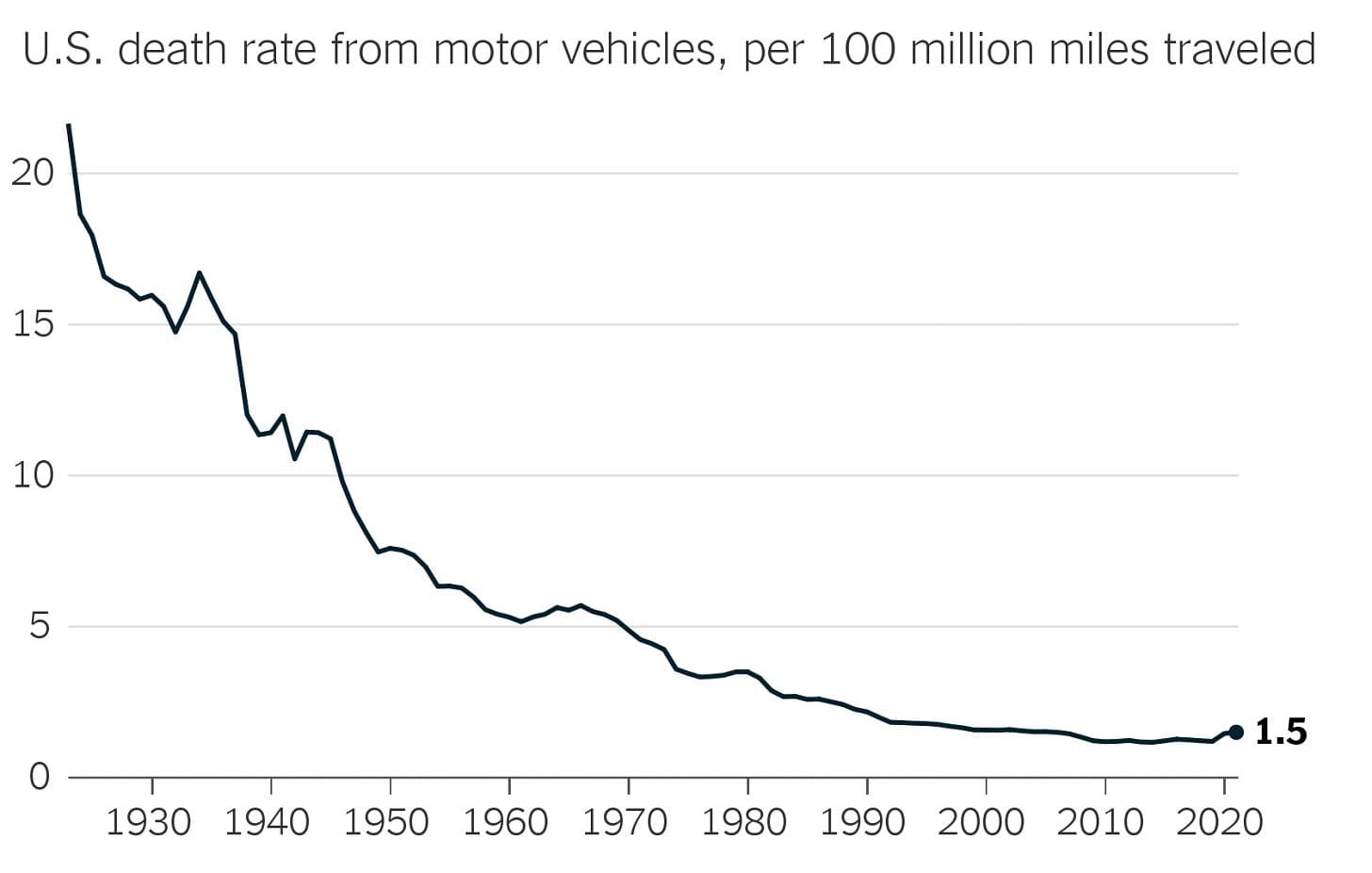
Unfunny thing: People still say that cars kill children since they remain one of the leading killers of…children. Regulations fought for by dogged advocates over many decades and the “norm” of chasing kids indoors to try to keep them safe have done much but only so much.
Despite our laws, enforcement, education, and street engineering, tens of thousands of Americans still die sudden, violent deaths in crashes annually and several millions are injured in them, often dreadfully. To Huang, these human costs are acceptable, invisible costs that should not enter into our calculations when considering our nation's historical embrace of the car. Acceptable and invisible, we can presume, are what he hopes to make the costs of AI.
Over the past century-plus America reshaped the landscape for cars rather than people. This transformation of the physical landscape was so dramatic, it made us overly dependent on them, which helped feed a culture that largely accepts those deaths and injuries as the necessary cost of mobility and a vibrant economy. Today, Americans are killed by cars at a rate four times that of the UK or Germany.
A bit later in the interview, Huang struggled to provide an example of the kind of “social norms” he thinks will make Americans more positive toward AI. But if keeping kids indoors is what he means by a norm of our car system, then it's clear he expects Americans will develop burdensome and unhealthy coping mechanisms and a willingness to absorb pain on behalf of the perceived and real benefits of AI. He’s ready for Americans to eat AI’s numerous high costs.
Americans have generally tolerated cars' major contribution to air pollution, which has led to a host of health impacts including tens of thousands of annual premature deaths; we accept that these costs are disproportionately borne by people of color and low-income households. Cars are a key driver of climate change but many look away and toward their convenience and comfort, toward the idea that they bring freedom, toward the lack of transportation options, and toward the economic growth mobility produces.
 Anne Lutz Fernandez
It may be reasonable then for the tech bros to expect many Americans to ignore, discount, or have hidden from them the health and environmental harms produced by AI data centers, which also have a disparate impact. The frenzied building of data centers presents a dramatic threat to the planet from climate change.
As the car altered the physical landscape, it altered the social and economic landscape. It enabled White Americans to self-segregate in suburbs and facilitated the hollowing out of many cities as thriving Black neighborhoods were bisected by highways and corporations relocated to far-flung locations, taking jobs with them that could only be reached by car owners. Car overdependence has added to the loneliness epidemic, making it harder for people to stay connected.
Now AI threatens massive job losses and dislocation. It also promises to exacerbate Americans' decline in socializing: The industry offers AI agents to replace employees and service-providers and AI companions to replace lovers, mentors, and friends.
Then there's the inequality AI will generate. Our experience with cars helps show where that will go. Cars — which most need to get and keep a job — suck money out of individuals, families, small businesses, and communities and funnel it to huge corporations. So too will AI as its corporate users cut middle management and entry-level jobs and as its providers, already some of the wealthiest enterprises and individuals in the world, profit from the uncompensated work of artists, writers, and other workers and the exploitation of workers overseas.
The political power built up by the fossil fuel companies in the US as a result of how we have reshaped the nation for cars is staggering. It owns our politicians and leads us into wars. Consider the power that a nation reshaped for AI — where students and teachers, managers and workers, consumers, businesses, and government, including the military, can't function without it — will give to the already powerful tech bros.
Look at what the fossil fuel industry has done to our domestic politics, warping the minds of citizens into supporting its financial interests in the name of "freedom," and compare this to the power the tech bros can build with AI and its unfathomable ability to surveil, spread propaganda, and indoctrinate.
 Anne Lutz Fernandez
And unlike cars, AI can actually hunt down and kill people. As the Quincy Institute’s Janet Abou-Elias and William Hartung laid out in The Nation, “the Pentagon has gone all in on artificial intelligence.” The pair explains that Defense Secretary Pete Hegseth is pursuing AI across the military apparatus at a breakneck speed without apparent guardrails and in ways that will enrich a few while concentrating decision-making at the very top, subverting the balance of power and increasing the chances of dangerous actions and costly overspending.
In the end, during his interview with the AP, Huang couldn’t even come up with a parallel example for AI to sidewalks and crosswalks, some of those things the government pays for so that cars kill fewer people. His answer instead was, "First, I would advocate that everybody use AI."
This was his first answer, but also his second. Repeatedly urging trial as though reasonable adults with meaningful concerns are oppositional-defiant toddlers resisting new things, Huang telegraphed that he doesn't want norms, he wants normalization.
So now I'm not going to pass out. My anger has revived me.
The tech bros need citizens, consumers, and workers to stop asking questions, stop demanding regulations. They need all to pursue the DOD's path: use first, ask nothing later, just adapt to the new world made for and by AI.
It's doubtful they believe that "everybody" trying genAI will be so damn impressed it produces the mass euphoria needed to speed the re-landscaping. Of course they know that many of those calling for regulation and resisting AI mania have already experimented with genAI. And we know that they have worked to make it so psychologically rewarding to use that it is potentially addictive — enough so, they must hope, to bridge the gap until so many institutions, groups, and individuals are using it that, like the car, that AI becomes indispensable, compulsory consumption.
It's sadly telling that Huang chose the example of cars killing children. The analogy exposes the desire to swiftly reshape our social, political, economic, and physical landscape to accommodate AI’s needs the way they were eventually reshaped for cars. Never mind what this does to our children and the world they will inherit from us.